
A Complete Guide to Tote Bag Printing Techniques
Introduction: Why Printing Methods Matter for Tote Bags
The printing process defines not only the appearance of your tote bags, but also the brand value they communicate. A well-chosen printing technique ensures vibrant colors, long-lasting durability, and a professional finish.
In this article, we’ll explore seven major printing techniques for custom tote bags — including gravure, screen, flexographic, digital, heat transfer, sublimation, and vinyl printing — to help you understand their differences, pros and cons, and how to choose the right one.
Common Printing Techniques for Tote Bags
1. Gravure Printing
Technology Overview: Gravure printing uses engraved cylinders to transfer ink onto materials like OPP film.
Best For: Large-volume printed tote bags made with laminated or film-coated materials.
Advantages:
- Exceptional color saturation and clarity
- Highly durable and waterproof
- Ideal for mass production
Disadvantages:
- High setup cost due to plate engraving
- Less flexible for small-batch customization
Ideal Use Case: Premium custom tote bags with detailed artwork or full-color brand logos.
2. Silk Screen Printing
Technology Overview: Ink is pushed through a mesh stencil onto the fabric surface.
Best For: Non-woven, cotton, or canvas tote bags.
Advantages:
- Strong color density and layered texture
- Cost-effective for medium-sized orders
- Excellent for bold logos and simple graphics
Disadvantages:
- Time-consuming process for complex designs
- Limited in producing gradients or photographic details
Ideal Use Case: Reusable tote bags for promotional events, retail packaging, and branding campaigns.
3. Flexographic Printing
Technology Overview: A flexible resin plate and quick-drying ink are used for high-speed printing on roll materials.
Best For: Non-woven rolls, kraft paper, and lightweight eco-friendly tote bags.
Advantages:
- High printing speed for mass production
- Uses water-based inks that are eco-friendly
- Lower overall cost compared to gravure
Disadvantages:
- Lower resolution
- Limited color accuracy
Ideal Use Case: Supermarket and grocery tote bags requiring fast turnaround.
4. Digital Printing
Technology Overview: Digital printers apply ink directly to the material without plates.
Best For: Small batches of custom tote bags requiring complex color designs.
Advantages:
- No plate fee, ideal for small or customized orders
- Fast turnaround and design flexibility
- Supports photo-quality printing and gradients
Disadvantages:
- Slightly higher cost per piece
- Not suitable for ultra-large production volumes
Ideal Use Case: Personalized printed tote bags for online brands or limited editions.
5. Heat Transfer / Vinyl Printing
Technology Overview: Designs are printed on transfer film and then heat-pressed onto the bag surface.
Best For: Small batches or limited-edition custom tote bags.
Advantages:
- Vibrant color output
- Sharp and clean image edges
- Perfect for small, detailed graphics or logos
Disadvantages:
- Limited durability over time
- Not suitable for full-surface coverage
Ideal Use Case: Event giveaways, fashion tote bags, or seasonal promotional bags.
6. Sublimation Printing
Technology Overview: Sublimation turns dye into gas, allowing it to penetrate polyester or RPET fibers.
Best For: Polyester and RPET eco-friendly tote bags.
Advantages:
- Fade-resistant and long-lasting
- Produces brilliant full-color images
- Eco-friendly process with minimal waste
Disadvantages:
- Works only with polyester-based fabrics
- Cannot be used on cotton or natural fibers
Ideal Use Case: Vivid full-color RPET tote bags or sustainable brand packaging.
7. Heat Transfer Printing
Technology Overview: Designs are printed onto transfer paper and then heat-pressed onto the bag material.
Best For: Non-woven, canvas, and polyester tote bags.
Advantages:
- High-resolution photo-quality images
- Accurate color reproduction
- Great for small custom runs
Disadvantages:
- Higher per-unit cost
- Requires precise temperature control
Ideal Use Case: Premium custom tote bags for brands emphasizing image quality.
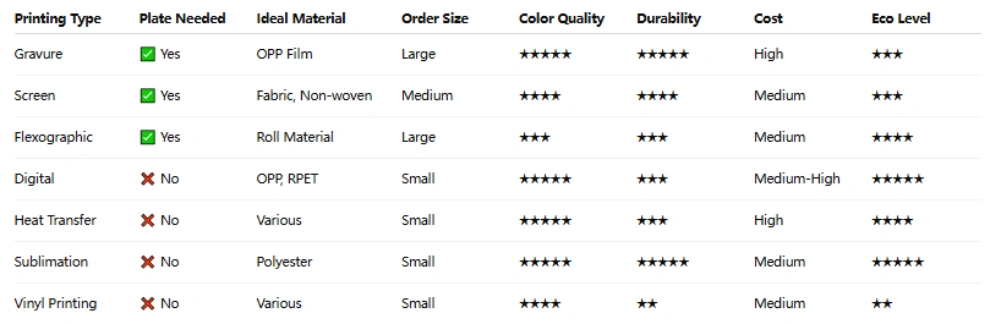
Comparison of Printing Methods
How to Choose the Right Printing Method
1. By Quantity
- Large orders → Gravure or Flexographic
- Small or custom batches → Digital or Sublimation
2. By Material
- Non-woven → Screen or Heat Transfer
- Polyester / RPET → Sublimation
- OPP Film → Gravure or Digital
3. By Design Type
- Photo-quality or gradient images → Digital or Sublimation
- Simple logo text → Screen or Flexographic
4. By Budget
- Cost-sensitive → Screen printing
- High-end branding → Digital or Gravure
Future Trends in Tote Bag Printing
The future of tote bag printing lies in eco-friendly materials, water-based inks, and digital customization.
Brands increasingly choose RPET tote bags combined with digital or sublimation printing to achieve sustainability, vivid visuals, and low MOQ production.
Conclusion
Choosing the right printing process can turn your tote bags into powerful brand messengers.
At WhoseBags, we combine 12+ years of experience, multiple printing technologies, and sustainable materials to help global clients create custom tote bags that are stylish, durable, and eco-conscious.
👉 Learn more at whosebags.com/services or whosebags.com/contact